First Bus Boss Hints at Big Plans for Stamford Brook Garage
Underused site could 'burst back to life' with electrification
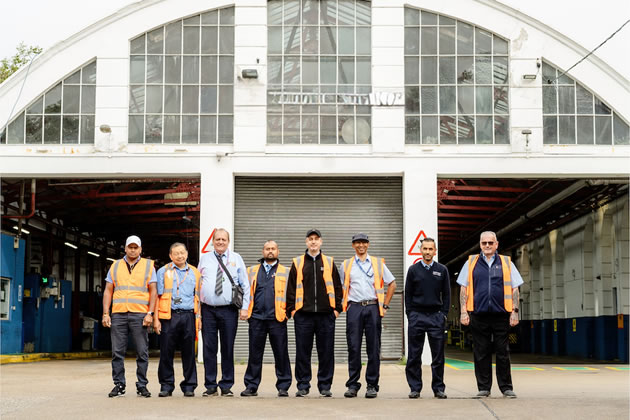
Staff at Stamford Brook Garage. Picture: First Bus
January 10, 2026
One of London’s oldest surviving bus depots — and a landmark of the capital’s tramway heritage — is being lined up for a major transformation as First Bus explores plans to electrify Stamford Brook Garage. The move forms part of the company’s wider ambition to convert almost all its London depots to zero-emission operation by 2030.
The proposal, first highlighted by Evening Standard transport editor Ross Lydall, comes as First Bus managing director Bill Cahill warned that electrifying London’s entire bus fleet by the Mayor’s 2030 target will be “next to impossible” without major upgrades to the capital’s power infrastructure and stronger financial incentives from Transport for London (TfL).
Stamford Brook Garage, on the border of Chiswick and Hammersmith, dates back to 1896 and is believed to be the oldest operational bus garage in London. Its roots stretch even further: the site was used in the 1850s and 1860s for horse-drawn trams, before becoming a key depot for the London United Electrical Tramways, whose trams once ran from Hampton Court to Shepherd’s Bush Green.
Next door stands the red-brick Power House, built to supply electricity to those early trams. Today it houses the Metropolis recording studios, but the pairing of the two buildings is a reminder of the city’s transition from horse-power to electric traction.
Despite its size — the depot can house around 100 buses — Stamford Brook currently operates at roughly half capacity. It serves just four routes (220, 272, 440 and E3), none of which are fully electrified. Chiswick High Road is part of a Low Emission Bus Zone which means diesel only routes are not allowed to operate along it.
“This garage has been under-utilised for some time, mainly because it’s quite difficult to electrify,” Mr Cahill told the Standard. “But when we electrify it, it will burst back into life.”
He also hinted at a significant, undisclosed innovation planned for the site, describing it as “something… different to anything elsewhere”, though he declined to reveal details.
Mr Cahill stressed that electrifying depots is far more complex than purchasing new buses.
“You don’t plug an electric bus into a 13-amp socket,” he said. “It’s a very high-voltage system that takes a lot of planning. There is limited power in the London Grid. You have to book your power up to five years in advance.”
He warned that the difficulty of securing grid capacity is becoming a “barrier to entry” for new operators and a major constraint on the pace of electrification.
TfL has said it expects the entire London bus fleet to be zero-emission by 2034 without additional Government funding — four years later than the Mayor’s target.
A First Bus London spokesperson confirmed that Stamford Brook is part of its long-term electrification strategy but emphasised that no final decisions have been made.
“Stamford Brook Garage forms part of our wider plans to electrify our fleet, but we remain at the early stages of exploring options and assessing feasibility,” the spokesperson said.
The garage’s new general manager, Carl Trainor, appointed in 2024, has a background in zero-emission operations and is tasked with helping turn Stamford Brook into “one of West London’s all-electric transport hubs”.
TfL also confirmed that the project remains in the feasibility phase, saying it is “working closely with First Bus as they explore options”.
First Bus has ordered 60 new BYD electric double-deckers, capable of up to 500 miles on a single charge — enough for two to three days of service. Forty will operate on route 18, with the remainder on route 31.
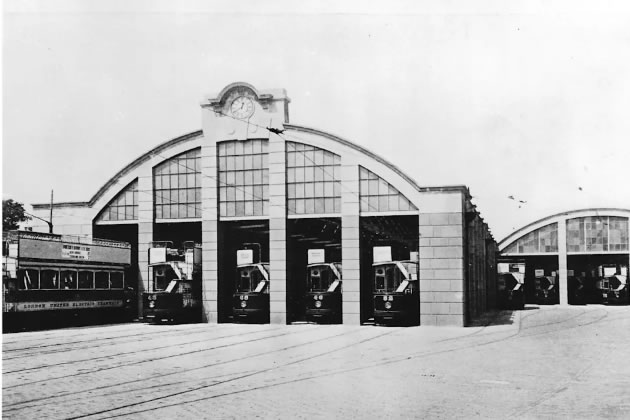 Stamford Brook Garage when it was a depot for trams. Picture: First Bus
The company already runs around 350 of the Chinese company's vehicles, with the new order taking its total to about 420. The rest of its London fleet consists of roughly 400 diesel-hybrids and fewer than 200 “light diesels”.
In the same interview with the Evening Standard, Mr Cahill criticised the impact of road layouts on bus speeds, singling out King Street in Hammersmith as one of London’s worst bottlenecks.
The street is now westbound-only for vehicles, with a bi-directional cycle lane occupying the former eastbound carriageway. Cahill said buses frequently queue outside Marks & Spencer, causing tailbacks stretching to the Hammersmith gyratory.
“It’s basic plumbing,” he said. “If you squeeze a hosepipe in the middle, the water will come out somewhere else. You see not very many bikes and a queue of buses.”
He warned that slow bus speeds — often below walking pace — are driving passengers away.
TfL defended the King Street layout, saying safety was the priority.
“Reliable bus services with attractive journey times are essential,” a spokesperson said. “Safety is our top priority, and King Street is an example of a location where the allocation of road space has been adjusted to ensure safety.”
TfL said bus speeds vary widely depending on time and location and that it “constantly monitors” the network to keep London moving “safely and effectively”.
With feasibility work underway, Stamford Brook could begin its transition within the next 12 to 24 months, though much depends on power availability, TfL contracts and the pace of London’s wider electrification programme.
If the project proceeds, it may present the opportunity to reverse the decline in the number of buses serving Chiswick High Road which is estimated to be down by around a third over the last decade due to service cuts such as the curtailment of route 27. However, declining traffic speeds along the High Road may make it difficult to increase the number of buses using it.
Find Articles Like This Useful? Help Us Produce More This site remains committed to providing local community news and public interest journalism. Articles such as the one above are integral to what we do. We aim to feature as much as possible on local societies, charities based in the area, fundraising efforts by residents, community-based initiatives and even helping people find missing pets. We’ve always done that and won’t be changing, in fact we’d like to do more. However, the readership that these stories generates is often below that needed to cover the cost of producing them. Our financial resources are limited and the local media environment is intensely competitive so there is a constraint on what we can do. We are therefore asking our readers to consider offering financial support to these efforts. Any money given will help support community and public interest news and the expansion of our coverage in this area. A suggested monthly payment is £8 but we would be grateful for any amount for instance if you think this site offers the equivalent value of a subscription to a daily printed newspaper you may wish to consider £20 per month. If neither of these amounts is suitable for you then contact info@neighbournet.com and we can set up an alternative. All payments are made through a secure web site. One-off donations are also appreciated. Choose The Amount You Wish To Contribute. If you do support us in this way we’d be interested to hear what kind of articles you would like to see more of on the site – send your suggestions to the editor. For businesses we offer the chance to be a corporate sponsor of community content on the site. For £30 plus VAT per month you will be the designated sponsor of at least one article a month with your logo appearing if supplied. If there is a specific community group or initiative you’d like to support we can make sure your sponsorship is featured on related content for a one off payment of £50 plus VAT. All payments are made through a secure web site. |