High Court Hears Case Against Ealing Children's Centre Closures
Judicial review is challenging council's decision as unlawful
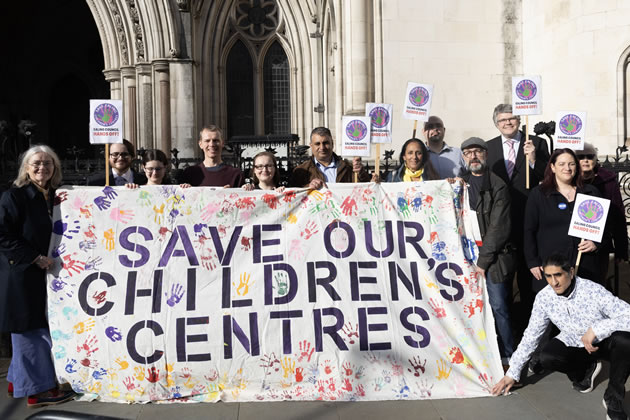 Save Our Children's Centres supporters demonstrate in front of the High Court. Picture: Facundo Arrizabalaga/MyLondon
February 27, 2026
Ealing Council has had to defend its decision to close 10 children centres at the High Court this week.
On Tuesday, February 24, and Wednesday, February 25, Ealing Council faced a judicial review over the controversial policy which has been described as “unlawful”. The case, which was brought by parents on behalf of a two-year-old child – who cannot be named for legal reasons – argues that the consultation process around the closure broke the law.
The claimant, represented by Jenni Richards KC, brought the case on three grounds. It was argued that the consultation was unlawful because the proposals were not consulted on at a formative stage – meaning that a decision to close the centres had already been made prior to a consultation – and because consultees were not given enough reasons or information to properly consider the policy.
The council argue that the simple fact it is only closing 10 centres, having initially decided to close 12 is proof that the policy was at a formative stage and open to change at the time of the consultation.
Second, Ms Richards argued that the council closed the children’s centres without ensuring that enough services would be available, particularly for families who rely on them most. Local authorities have a legal obligation to make sure there are enough children’s centres and services in the area, which the claimant argued the council has failed to do.
Finally, the claimant insisted that the decision to close 10 centres was “irrational” because it ignored key evidence, and consultation responses. The defence argued that by bringing services into people’s communities, the council acted entirely rationally.
The hearing was attended by 16 people supporting the claimant, mostly from Save Ealing Children’s Centres. Liberal Democrat Councillor Jon Ball was also in attendance.
From the council, Cabinet Member for a Fairer Start, Cllr Josh Blacker was in attendance, alongside Helen Harding, Assistant Director of Early Help and Prevention, and Kulsuma Faiz, the Strategic Project Manager.
Speaking inside Courtroom 3 at the Royal Courts of Justice, Ms Richards argued that throughout the consultation process, Ealing Council purposefully misled the public about the reasons for the closure, which according to the claimant was primarily a financial decision. In council documents, the “need” for the savings generated by the closure was outlined, however in the consultation material, this did not appear as such.
Defending the consultation process, Rory Dunlop KC described the savings as a benefit to the council, but reaffirmed that it was merely a benefit of the primary goal, which the council maintains was improving the early help offered in the borough.
He said: “In determining the need for children’s centres, value for money and services are key, how can we improve outcomes for families with the greatest need. Second, and it is second, is the value for money – it is part of every decision a local authority must make.”
Another point raised by the defence was that the existing “25 children’s centres” were not actually children centres defined in law. In fact, despite the council professing to have 25, it only has seven.
This is because in law, a certain amount of services must be provided for somewhere to be considered a children’s centre. Instead, the rest are known as “link sites” providing children’s services. In legal terms, this means the borough will only have four children’s centres post closure, with three being closed.
A point of contention between both sides related to the amount of data residents required in order to make a well-informed contribution to the consultation. The council did not explain its rationale on why the ten centres identified to close were picked.
Council lawyers argued that the public did not require any more information to make a well-informed decision, reading aloud detailed and coherent arguments put across during the consultation. During an interview with the Local Democracy Reporting Service (LDRS), Cllr Peter Mason, Leader of the Council, outlined that many people feel afraid of going to council buildings due to stigma, and as such do not receive the help they need.
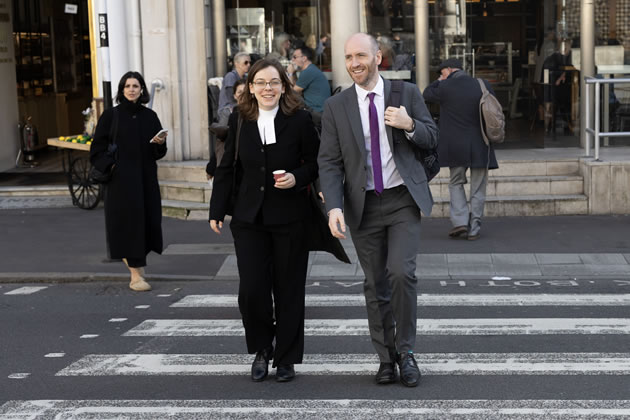
Cllr Josh Blacker crossing the road in front of the court. Picture: Facundo Arrizabalaga/MyLondon
This was something which was put across by the defence, citing 2024 research appearing to suggest something similar generally. However, on day two of the hearing, this was shot down by the counsel on behalf of the claimant.
“There is a reliance on the 2024 research. First, the 2024 research doesn’t actually say what they say it says, and secondly, there is no evidence that it was before the decision maker, nor that the research formed any part of the consultation.
“The information wasn’t in the consultation, nor was a link provided. It is a feature of the submissions given by the local authority and given the context of this consultation, a surprising one – you could have found it online.”
Speaking outside court upon the conclusion of the hearing, Claire Welsby, a former senior council officer and a lead campaigner for Save Ealing Children’s Centres, said: “It didn’t have to get to this stage if the council listened to Save Ealing Children’s Centres last year but it took a family representing their child to come forward and to take on this challenge.”
Overseeing the review and making the decision is Mr Justice Kimblin. Should the judge rule in favour of the two-year-old and consider the decision “unlawful”, the claimant has requested the quashing of the council’s decision to close ten centres and a reimbursement of costs associated with bringing the case.
Philip James Lynch - Local Democracy Reporter
Like Reading Articles Like This? Help Us Produce More This site remains committed to providing local community news and public interest journalism. Articles such as the one above are integral to what we do. We aim to feature as much as possible on local societies, charities based in the area, fundraising efforts by residents, community-based initiatives and even helping people find missing pets. We’ve always done that and won’t be changing, in fact we’d like to do more. However, the readership that these stories generates is often below that needed to cover the cost of producing them. Our financial resources are limited and the local media environment is intensely competitive so there is a constraint on what we can do. We are therefore asking our readers to consider offering financial support to these efforts. Any money given will help support community and public interest news and the expansion of our coverage in this area. A suggested monthly payment is £8 but we would be grateful for any amount for instance if you think this site offers the equivalent value of a subscription to a daily printed newspaper you may wish to consider £20 per month. If neither of these amounts is suitable for you then contact info@neighbournet.com and we can set up an alternative. All payments are made through a secure web site. One-off donations are also appreciated. Choose The Amount You Wish To Contribute. If you do support us in this way we’d be interested to hear what kind of articles you would like to see more of on the site – send your suggestions to the editor. For businesses we offer the chance to be a corporate sponsor of community content on the site. For £30 plus VAT per month you will be the designated sponsor of at least one article a month with your logo appearing if supplied. If there is a specific community group or initiative you’d like to support we can make sure your sponsorship is featured on related content for a one off payment of £50 plus VAT. All payments are made through a secure web site. |