Hammersmith Bridge Features in New Augmented-reality Trail
Project aims to help understanding of its past and future
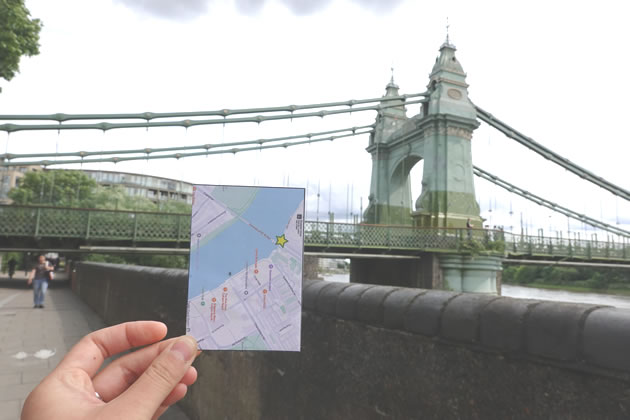
A heritage trail guides visitors through key moments in the bridge’s history
September 7, 2026
The Totally Thames 2026 festival will place Hammersmith Bridge at the centre of a major new public engagement project that invites Londoners to explore the structure’s past, understand its long-running engineering challenges and consider what its future might look like.
The initiative, Restoring London’s Bridges, is being delivered by the Thames Festival Trust and the Royal College of Art, and uses mixed-reality technology, augmented-reality trails and live discussions.
Hammersmith Bridge has been a subject of intense debate for years. First opened in 1887 and redesigned by Sir Joseph Bazalgette in 1895, it has undergone repeated interventions throughout its life. Its most recent closure in April 2019, triggered by the discovery of microfractures in the pedestals, led to years of disruption and uncertainty. Limited access for pedestrians and cyclists returned in 2021, and the bridge became fully pedestrianised in 2025, but the question of whether it should ever carry vehicles again remains unresolved. The exhibition aims to give Londoners a clearer understanding of why the bridge has proved so difficult to maintain and what the realistic options are for its future.
Visitors will be able to step inside a mixed-reality reconstruction of the bridge, walking around a detailed digital model and clicking on structural elements to hear stories about its design, maintenance and deterioration. The experience shows how Victorian materials respond to stress, temperature and vibration, and illustrates the engineering dilemmas behind the bridge’s long closure.
An augmented-reality heritage trail adds another layer, guiding visitors through key moments in the bridge’s history—from Bazalgette’s redesign to the discovery of cracks, the 2019 shutdown and the debates that shaped its pedestrianisation. The trail uses Web-AR, meaning no app download is required, and is designed to be accessible to all ages.
A public discussion at the RCA’s Battersea campus on 19 September will bring together engineers, historians and heritage specialists to examine the future of London’s bridges. Among those taking part are Peter Bazalgette, great-great-grandson of Sir Joseph Bazalgette, and Dr Mehdi Kashani, a bridge specialist at the National Infrastructure Laboratory. The session will explore how Londoners can be meaningfully involved in decisions about heritage structures like Hammersmith Bridge and Albert Bridge, and how engineering, conservation and public expectations intersect.
The project is also designed as a community-centred placemaking exercise, delivered with museums, heritage organisations, schools, colleges and elderly activity centres. Its aim is to help residents understand why closures happen, how engineering decisions are made and what sustainable river crossings might look like in the future. Participants will be asked to complete questionnaires before and after the experience to measure how the XR sessions affect their understanding of local history, infrastructure planning and the complexities of maintaining Victorian bridges in a modern city.
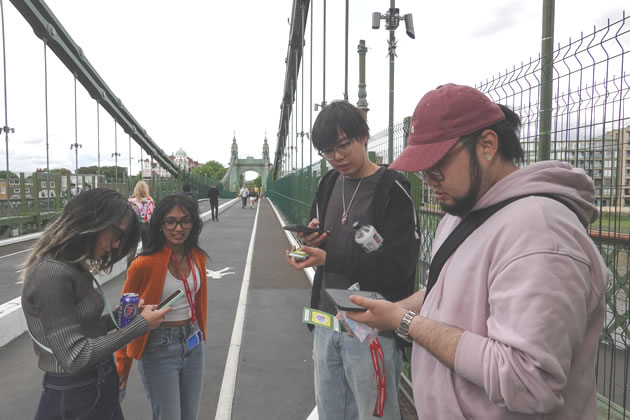
Visitors will be able to step inside a mixed-reality reconstruction of the bridge
Sessions will run on 19 September at the RCA Hangar Space in Battersea and on 20 September at Riverside Studios in Hammersmith, with low-cost tickets available for individuals and groups. A public-ready version of the experience will be completed this month, with a follow-up event planned for the 2027 festival.
More information and booking details here.
Like Reading Articles Like This? Help Us Produce More This site remains committed to providing local community news and public interest journalism. Articles such as the one above are integral to what we do. We aim to feature as much as possible on local societies, charities based in the area, fundraising efforts by residents, community-based initiatives and even helping people find missing pets. We’ve always done that and won’t be changing, in fact we’d like to do more. However, the readership that these stories generates is often below that needed to cover the cost of producing them. Our financial resources are limited and the local media environment is intensely competitive so there is a constraint on what we can do. We are therefore asking our readers to consider offering financial support to these efforts. Any money given will help support community and public interest news and the expansion of our coverage in this area. A suggested monthly payment is £8 but we would be grateful for any amount for instance if you think this site offers the equivalent value of a subscription to a daily printed newspaper you may wish to consider £20 per month. If neither of these amounts is suitable for you then contact info@neighbournet.com and we can set up an alternative. All payments are made through a secure web site. One-off donations are also appreciated. Choose The Amount You Wish To Contribute. If you do support us in this way we’d be interested to hear what kind of articles you would like to see more of on the site – send your suggestions to the editor. For businesses we offer the chance to be a corporate sponsor of community content on the site. For £30 plus VAT per month you will be the designated sponsor of at least one article a month with your logo appearing if supplied. If there is a specific community group or initiative you’d like to support we can make sure your sponsorship is featured on related content for a one off payment of £50 plus VAT. All payments are made through a secure web site. |