Ealing Residents Generate Less Rubbish than Anywhere in London
Borough best for dry recycling 'by some distance' according to new data
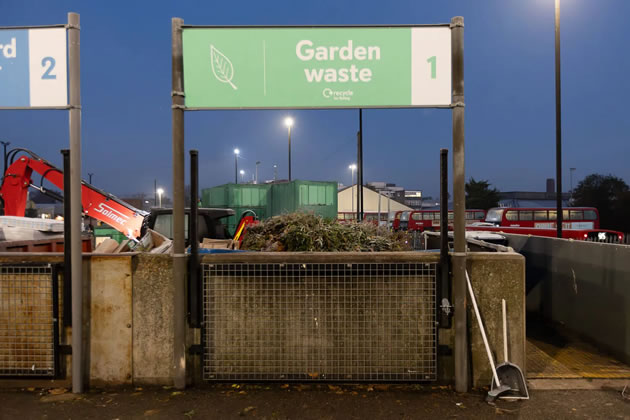
Garden waste collection at the council's depot in Greenford. Picture: Greener Ealing.
April 16, 2026
New government data published recently shows London's overall recycling rate has fallen to its lowest point since 2016 — dropping fractionally from 32.7% to 32.6%. The capital remains the second worst-performing region in England, behind only the North East. Against that grim backdrop, Ealing stands out as a relative success story but the picture from the borough is a puzzling one.
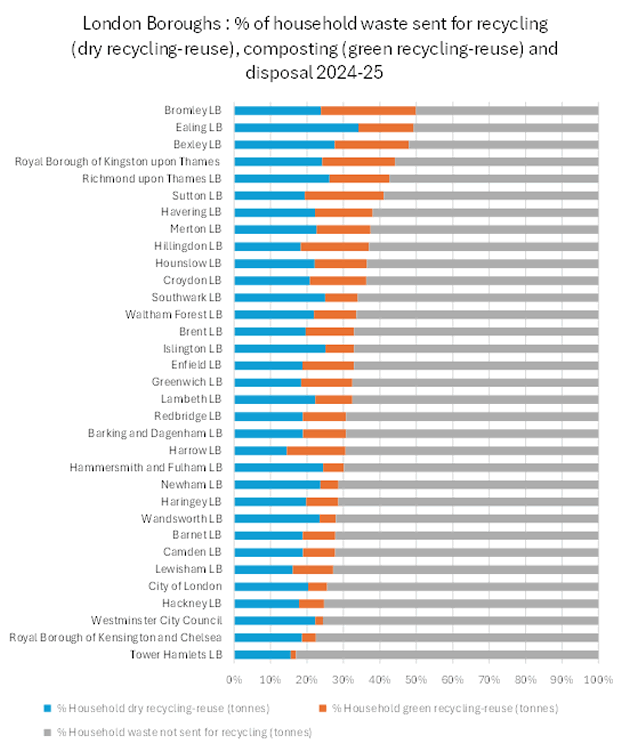
According to the London Borough Recycling Scorecard 2026, compiled by CPRE London, Ealing has the highest dry recycling rate in the capital — and not by a narrow margin. Dry recycling covers the everyday household materials most people are most familiar with: paper, metal, glass and plastic. On that measure, Ealing is, in the words of the scorecard, ahead of every other London borough "by some distance."
Ealing's overall recycling rate which includes garden waste is just under 50% and the second highest in the capital. Bromley retains its position as London's best-performing borough overall.
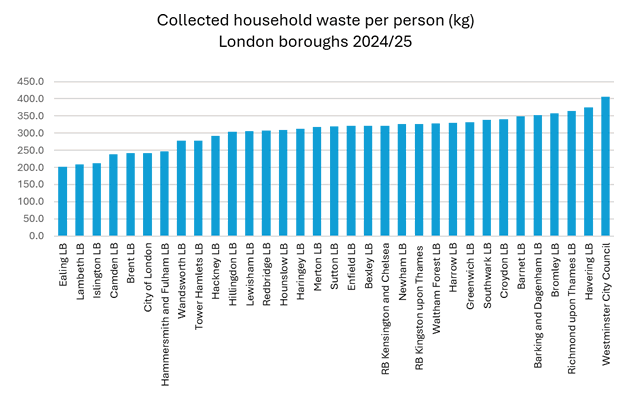
The borough also records the lowest overall volume of waste collected per person anywhere in London, at just 201kg per head less than half of Westminster's 406kg at the top end. In other words, Ealing residents generate less rubbish than anywhere else in London.
The reasons for the high dry recycling rate and low average weight of waste per person in Ealing are not immediately obvious. Bromley has a relatively high weight collected per person to go with its high recycling rates.
Asked about the apparent contradiction, Ealing Council suggested the divergence reflects year-on-year variation in garden and food waste tonnages rather than any single policy change. The council also noted that some of the behaviours that reduce waste — home composting, for instance, or actively preventing food waste in the first place — are genuinely positive from an environmental perspective, even if they make the borough's measured recycling rate look lower than it might otherwise be. Waste that is never created, or never collected because it has been composted privately, does not appear in the figures at all.
The council was asked if rising prices for the garden waste collection service, or the ending of winter collections, might have reduced participation and therefore the weight of garden material being collected. The council acknowledged that its garden waste service had been subject to recent changes, but pointed to those changes as improvements — describing the service as now cheaper, more frequent and more accessible than before.
Separate questions about whether operational difficulties at Greenford or the closure of the Stirling Road recycling centre had affected the figures were also addressed. The council confirmed that a compactor issue at Greenford affected residual waste only and had no impact on garden waste acceptance, and noted that Stirling Road closed in 2021, making it irrelevant to the current data. It is possible that the issues at Greenford and the tendency of residents to take waste to tips outside the borough may be contributing to the low rates reported. However, it is possible to overstate the importance of this as a factor as at least 90% of waste collected across London boroughs is picked up at doorsteps rather than brought to tips by residents.
Source: CPRE London
Ealing's low overall waste figure within a broader London pattern. Nine of the 20 English local authorities with the lowest household waste collected per person are London boroughs, including all six of the lowest. Ealing, alongside Redbridge and Hackney, was also among the English authorities recording the largest decreases in waste per person compared to the previous year.
An Ealing Council spokesperson said the borough was "delighted" by the recognition of its dry recycling performance and its low overall waste volumes, adding that "reducing overall waste and moving towards a circular economy where materials are in use for as long as possible" was the overarching goal. The council said it continuously reviews its waste and recycling services and remains "proud" of its position among the strongest performers in London.
Source: CPRE London
CPRE London was less celebratory about the wider picture. Alice Roberts of CPRE said London boroughs too often claim it is too hard to improve recycling rates in a dense urban environment — a claim she dismissed. "Most Londoners have comprehensive recycling services, including food waste collections," she said, arguing that the priority should be extending those services to all households and improving communications with residents. She called for enforcement measures — warning stickers, fines for persistent non-recyclers — pointing to Wales as evidence that such approaches work.
"Every year new data shows no progress," she said. "This isn't just an environmental disaster, it's a huge waste of taxpayers' money."
We have asked CPRE London for its interpretation of the figures for Ealing Borough.
Like Reading Articles Like This? Help Us Produce More This site remains committed to providing local community news and public interest journalism. Articles such as the one above are integral to what we do. We aim to feature as much as possible on local societies, charities based in the area, fundraising efforts by residents, community-based initiatives and even helping people find missing pets. We've always done that and won't be changing, in fact we'd like to do more. However, the readership that these stories generates is often below that needed to cover the cost of producing them. Our financial resources are limited and the local media environment is intensely competitive so there is a constraint on what we can do. We are therefore asking our readers to consider offering financial support to these efforts. Any money given will help support community and public interest news and the expansion of our coverage in this area. A suggested monthly payment is £8 but we would be grateful for any amount for instance if you think this site offers the equivalent value of a subscription to a daily printed newspaper you may wish to consider £20 per month. If neither of these amounts is suitable for you then contact info@neighbournet.com and we can set up an alternative. All payments are made through a secure web site. One-off donations are also appreciated. Choose The Amount You Wish To Contribute. If you do support us in this way we'd be interested to hear what kind of articles you would like to see more of on the site – send your suggestions to the editor. For businesses we offer the chance to be a corporate sponsor of community content on the site. For £30 plus VAT per month you will be the designated sponsor of at least one article a month with your logo appearing if supplied. If there is a specific community group or initiative you'd like to support we can make sure your sponsorship is featured on related content for a one off payment of £50 plus VAT. All payments are made through a secure web site. |