Impact of Tube Driver Strikes Appears to Be Reducing
Figures show increased number of union members turning up for work
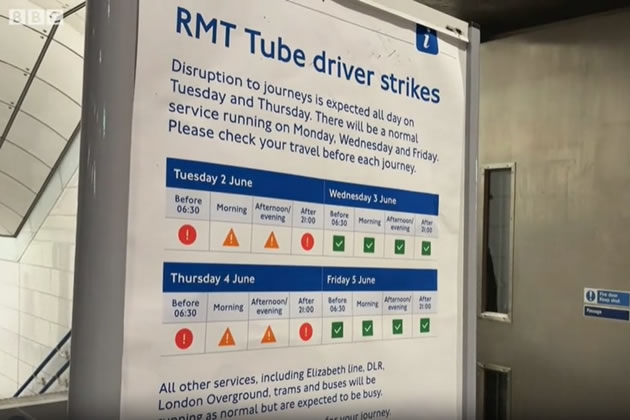
Thursday's strike is currently the last scheduled in the dispute
June 4, 2026
London’s latest round of Tube driver strikes has proved highly disruptive, but the scale and character of the impact has shifted compared with earlier walkouts in the long-running dispute over a proposed four-day working week. While disruption continued through Thursday (4 June) the effect of the action is expected to end by Friday morning.
Passenger data, service levels and union turnout for the first day of the latest disruption all point to a pattern: while the strikes continue to cause widespread inconvenience, they are biting differently than those seen in April and May — and the likelihood of further action remains finely balanced.
Tuesday’s (2 June) walkout saw severe disruption across the network, but Transport for London (TfL) was able to run around half of normal services during the morning peak, thanks to roughly 60% of drivers reporting for duty, slightly higher than the 57% turnout recorded during April’s strikes. This meant that lines such as the Jubilee were able to operate close to normal early in the day, even as others experienced heavy delays or partial closures.
Passenger behaviour also reflected a shift. TfL data showed Underground usage down 43% compared with the equivalent day last year, but this was accompanied by increased demand on alternative modes: Elizabeth line up 17%, Overground up 9%, buses up 5%. These figures closely mirror patterns seen during earlier strikes, but the overall network remained more resilient than during the most disruptive periods in 2023 and early 2024.
Weather conditions during this week's strike may have reduced the number of people walking or cycling to their destination
The impact has been far from negligible. Several lines — including the Circle, Piccadilly, parts of the Central and Metropolitan — saw no service or major suspensions, and London’s hospitality sector again reported a sharp drop in footfall. Hospitals warned of appointment delays, and commuters faced longer journeys as buses and rail alternatives became heavily congested.
Lines that have continued to operate have a higher proportion of drivers from ASLEF which is in favour of the four-day working week proposal. It is understood that the rise in drivers reporting for duty during the June strikes is accounted for by a small but significant increase in RMT members not participating in the industrial action.
Even with half the network running, the knock-on impact on roads, buses and alternative rail services continues to cause disruption across the city, and the economic cost — particularly to retail, hospitality and small businesses — remains substantial.
Talks between TfL and the RMT have repeatedly collapsed at the last minute, including five hours of Acas-mediated negotiations earlier this week. The union continues to argue that the proposed four-day week is a “compressed” schedule that risks fatigue, longer shifts and reduced flexibility — concerns it says have not been adequately addressed.
TfL, meanwhile, insists the new working pattern is entirely voluntary, initially limited to the Bakerloo line, and that the union should suspend action while discussions continue.
Although some planned June strike dates have been called off, the RMT has made clear that the dispute remains “live” and that it is prepared to schedule further walkouts if no progress is made. The union has also said it expects to meet TfL again next week, suggesting that negotiations are ongoing.
The RMT’s ballot for strike action in the Tube drivers’ four-day-week dispute closed on 24 February. Under UK law, a strike mandate lasts six months unless extended to nine months by agreement. There is no evidence of an extension in this case, so the default six-month period applies and the mandate is likely valid until late August. Until then, further strikes on this issue cannot be ruled out.
Like Reading Articles Like This? Help Us Produce More This site remains committed to providing local community news and public interest journalism. Articles such as the one above are integral to what we do. We aim to feature as much as possible on local societies, charities based in the area, fundraising efforts by residents, community-based initiatives and even helping people find missing pets. We've always done that and won't be changing, in fact we'd like to do more. However, the readership that these stories generates is often below that needed to cover the cost of producing them. Our financial resources are limited and the local media environment is intensely competitive so there is a constraint on what we can do. We are therefore asking our readers to consider offering financial support to these efforts. Any money given will help support community and public interest news and the expansion of our coverage in this area. A suggested monthly payment is £8 but we would be grateful for any amount for instance if you think this site offers the equivalent value of a subscription to a daily printed newspaper you may wish to consider £20 per month. If neither of these amounts is suitable for you then contact info@neighbournet.com and we can set up an alternative. All payments are made through a secure web site. One-off donations are also appreciated. Choose The Amount You Wish To Contribute. If you do support us in this way we'd be interested to hear what kind of articles you would like to see more of on the site – send your suggestions to the editor. For businesses we offer the chance to be a corporate sponsor of community content on the site. For £30 plus VAT per month you will be the designated sponsor of at least one article a month with your logo appearing if supplied. If there is a specific community group or initiative you'd like to support we can make sure your sponsorship is featured on related content for a one off payment of £50 plus VAT. All payments are made through a secure web site. |