New Project to Uncover Richmond Park's Lost Waterways
Archaeologists to investigate how water was supplied to royal residences
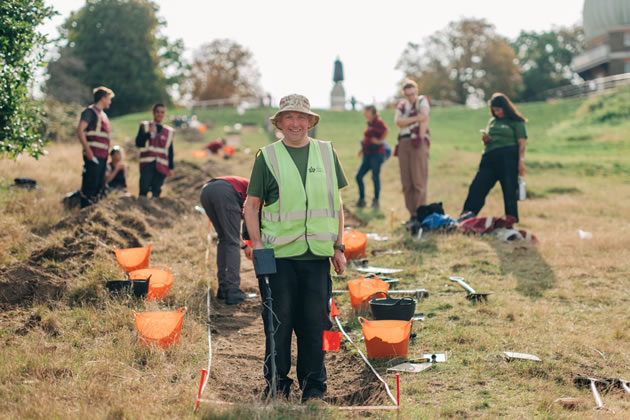
Andrew Mayfield will lead the project. Picture: The Royal Parks
July 24, 2026
Richmond Park, known today for its sweeping grasslands, ancient oaks and roaming deer, is about to reveal a very different side of itself — one that lies entirely underground. The Royal Parks charity has launched a major new archaeology project that will explore the historic water systems buried beneath three of London’s Royal Parks, beginning with Richmond Park.
The initiative, Lost Waterways of the Royal Parks, is funded by The National Lottery Heritage Fund with additional support from the Friends groups of Richmond Park, Greenwich Park and Bushy Park. Over the next three years, archaeologists will investigate the conduits, wells, reservoirs and tunnels that once supplied water to royal residences including the former Richmond Palace. Much of this infrastructure has been forgotten for centuries, surviving only as faint clues in the landscape or as undocumented cavities beneath the soil.
The Royal Parks has appointed archaeologist Andrew Mayfield to lead the project. His role will combine archaeological research with public engagement, ensuring that the discoveries made beneath Richmond Park are shared with the communities who use it today.
“Many of the Royal Parks’ most fascinating stories lie beneath the surface,” Mayfield said. “The Lost Waterways project will help us better understand and protect these historic water systems while giving local communities new opportunities to discover the archaeology and history that have shaped the parks over hundreds of years.”
Richmond Park’s hidden water systems are thought to date back to periods when the surrounding royal estates required reliable supplies for domestic use, gardens and livestock. Some may be linked to the elaborate waterworks of Richmond Palace, once one of the most important royal residences in England. Others may relate to later agricultural and landscape management. The project aims to map these features, understand how they were engineered, and assess their condition.
The research has a practical purpose as well as a historical one. By improving knowledge of the park’s underground water infrastructure, the findings will help the Royal Parks manage the landscape more sustainably — particularly as climate change increases pressure on water systems, soil stability and vegetation.
Crucially, the project is designed to be outward‑facing. Local communities, schools and volunteers will be invited to take part through guided walks, community digs, learning sessions and digital experiences. The aim is to help visitors understand the hidden layers of Richmond Park’s history and to encourage a sense of stewardship for the landscape.
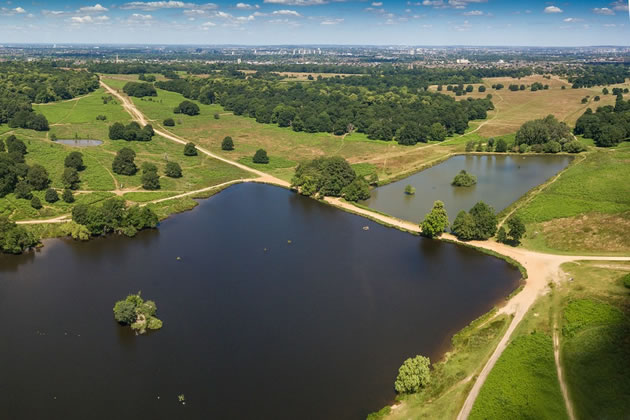
An aerial view of the lakes in Richmond Park. Picture: The Royal Parks
To mark the launch, Mayfield will lead a free guided walk in Richmond Park as part of the Council for British Archaeology’s Festival of Archaeology 2026. The walk, taking place at 2pm on Saturday 1 August, will explore how archaeology and nature intertwine — and how the park’s buried water systems have shaped the landscape visitors enjoy today.
The Lost Waterways project will run until 2029. Richmond Park is the first focus, with investigations moving on to Bushy Park and Greenwich Park in later phases. For now, the spotlight is firmly on Richmond, where centuries‑old engineering lies quietly beneath the bracken and grass, waiting to be rediscovered.
Like Reading Articles Like This? Help Us Produce More This site remains committed to providing local community news and public interest journalism. Articles such as the one above are integral to what we do. We aim to feature as much as possible on local societies, charities based in the area, fundraising efforts by residents, community-based initiatives and even helping people find missing pets. We've always done that and won't be changing, in fact we'd like to do more. However, the readership that these stories generates is often below that needed to cover the cost of producing them. Our financial resources are limited and the local media environment is intensely competitive so there is a constraint on what we can do. We are therefore asking our readers to consider offering financial support to these efforts. Any money given will help support community and public interest news and the expansion of our coverage in this area. A suggested monthly payment is £8 but we would be grateful for any amount for instance if you think this site offers the equivalent value of a subscription to a daily printed newspaper you may wish to consider £20 per month. If neither of these amounts is suitable for you then contact info@neighbournet.com and we can set up an alternative. All payments are made through a secure web site. One-off donations are also appreciated. Choose The Amount You Wish To Contribute. If you do support us in this way we'd be interested to hear what kind of articles you would like to see more of on the site – send your suggestions to the editor. For businesses we offer the chance to be a corporate sponsor of community content on the site. For £30 plus VAT per month you will be the designated sponsor of at least one article a month with your logo appearing if supplied. If there is a specific community group or initiative you'd like to support we can make sure your sponsorship is featured on related content for a one off payment of £50 plus VAT. All payments are made through a secure web site. |