Mayor Outlines Potential Heathrow Transport Problems
Says major upgrade of local infrastructure a pre-condition of a third runway
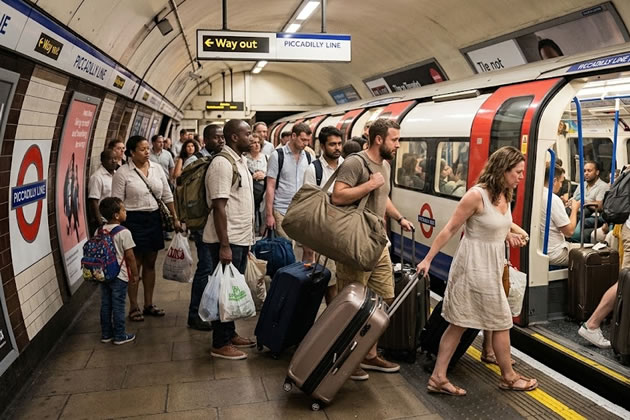
Sadiq Khan says funding for a the next stage of the Piccadilly line upgrade is essential if increased passenger demand is to be accommodated. Picture: AI Generated
September 1, 2026
The Mayor of London, Sir Sadiq Khan, has used his response to the Government's consultation on Heathrow's proposed third runway to issue a stark warning about the potential consequences for West London's transport network.
This week he published a series of reports written in collaboration with Transport for London and submitted as part of his reply to the proposal for a major expansion of the airport.
Heathrow is already one of the biggest transport generators in the west London, and its expansion would put additional passengers, employees, freight and construction traffic onto roads and railways that are already heavily used.
The Mayor's central argument is that Heathrow cannot be allowed to expand without first securing the transport improvements needed to accommodate its additional demand.
TfL estimates that, even if the Government's proposed targets for increasing the proportion of airport journeys made by sustainable transport are achieved, an expanded Heathrow could still generate around 60,000 additional highway trips every day. If the objective is to prevent any increase in road traffic, the amount of additional demand that public transport would have to absorb could be as much as 155 per cent above today's level.
The most obvious concern on the road network is the A4 which provides one of the principal approaches towards Heathrow running through Chiswick and Brentford. TfL's analysis warns that, even without expansion, the A4 plus sections of the M25, M4, Southern Perimeter Road and local roads around the airport are forecast to be operating at high levels of utilisation by 2041.
The problem, according to TfL, is that Heathrow expansion would be adding traffic to a system which already has relatively little spare capacity. TfL estimates that around 60,000 extra daily highway trips could result even if the Heathrow Expansion National Policy Statement (HENPS) targets are achieved.
Congestion at Heathrow does not stop at the airport boundary. Delays on the M4, A4, A3044 and local roads can affect journeys across a much wider part of West London.
TfL is particularly concerned about the A4, because Heathrow's proposed expansion requires part of it to be diverted and re-provided. The replacement road would be longer than the existing section. TfL says that because this diversion is required solely as a consequence of the third runway, Heathrow should pay not only the capital cost of constructing it but also the future maintenance and operational costs.
The Mayor and TfL also want TfL to have a formal role in approving the detailed design of the replacement A4. Their argument is that the new road must continue to accommodate essential traffic while improving conditions for buses, coaches and people walking and cycling.
TfL estimates that construction associated with the expansion would take place over two decades. That could mean a prolonged period of construction traffic, temporary road layouts, diversions and closures affecting the M25, A4, A3044 and local roads.
Even if the eventual road network is designed to work effectively, the process of building the airport could create years of disruption across West London. TfL says the HENPS needs to recognise this explicitly. It points to the arrangements used for HS2, where TfL was compensated for passenger-revenue losses resulting from highway delays caused by construction works, and argues that a similar mechanism should apply to Heathrow.
One of the submitted reports looks in detail at the issue of public transport. The Piccadilly line currently provides 12 trains per hour to Heathrow. The first phase of its long-awaited upgrade is already under way, bringing new air-conditioned, walk-through trains and increasing capacity by about 10 per cent per train. But TfL says that will not be enough on its own. The second phase of the upgrade, known as PLU2, would introduce major signalling improvements and additional rolling stock, allowing faster, more frequent and more reliable services including Turnham Green station finally being a fully-fledged stop. However, PLU2 is not currently funded and the Mayor and TfL believe it will be important if Heathrow expands and are pressing for it to be recognised as essential enabling infrastructure for the airport.
More passengers travelling to Heathrow by Tube could mean additional pressure on services and stations along the line. The Mayor's argument is therefore that Heathrow should not simply be allowed to generate more demand and expect the existing Piccadilly line to absorb it.
The Elizabeth line has already provided Heathrow with an important new connection to central and east London. There are currently six Elizabeth line trains per hour serving Heathrow. TfL says an additional two trains per hour are proposed, with the rolling stock needed for those services already funded and being delivered. The Mayor is also giving a further nudge to the government about his ambition for the Elizabeth Line to take over from the Heathrow Express when its contract expires in 2028.
TfL estimates that sustainable transport would have to accommodate a 100 per cent increase in demand compared with today if the Government's HENPS targets are achieved. To eliminate an increase in highway traffic altogether, the increase could be as high as 155 per cent. The Elizabeth line will therefore have to carry substantially more people if Heathrow expands.
That raises an important question for West London: how much of the additional Heathrow demand can the Elizabeth line accommodate without compromising its role for ordinary London journeys? TfL's response is that the answer cannot simply be to make existing services carry more people. Capacity needs to be expanded alongside the airport.
Perhaps the most significant part of TfL's response for West London is its support for new direct rail connections to Heathrow from the south and west.
At present Heathrow has good rail connectivity towards central London but virtually no direct rail connection from the south, west or north. That means a passenger travelling to Heathrow from much of Surrey or south-west London may have to travel via central London, take a bus or coach, or use a car.
One of the proposed services would run four trains per hour to Staines, Feltham, Twickenham, Richmond, Clapham Junction and Waterloo. A further four trains per hour would run towards Virginia Water and Woking, with two trains per hour continuing to Guildford and Basingstoke. To the west, four trains per hour are proposed towards Slough, Maidenhead and Reading. The new infrastructure could also allow four Elizabeth line services per hour to be extended to Staines.
A direct Heathrow–Richmond–Twickenham–Feltham–Staines–Waterloo service would give communities south of the airport a much more direct alternative to the car. It could also make it easier for airport employees to commute from across south-west London and Surrey.
That is important because TfL says airport staff are a particularly significant part of the transport problem. Employment sites are spread across the Heathrow campus, many without direct rail access, and shift workers often travel at times when rail services are less convenient.
Heathrow is already heavily connected towards central London, but a proposal to provide a link through to Waterloo would bring the airport directly into the South Western rail network. That would potentially create a completely new travel market between Heathrow and south-west London rather than simply adding passengers to the existing routes into Paddington and central London. But TfL also warns that the wider South Western network has its own capacity constraints.
Its response points to the need to address the constraints created by level crossings around Richmond and raises the possibility of a direct connection to the South West Main Line. It also identifies longer-term possibilities including Crossrail 2 and Underground extensions.
The Mayor's response is effectively saying that Heathrow expansion has consequences far beyond the airport itself. If Heathrow becomes significantly larger, the rail network feeding into Waterloo and the communities along those lines will also have to be considered.
The proposed West London Orbital is another potentially important part of the picture, although the Mayor's position here appears to be more nuanced.
TfL currently believes the Elizabeth line would provide a faster route to Heathrow for most people using the WLO corridor, while an extension of the WLO would face infrastructure and operational constraints.
Instead, TfL has highlighted the potential importance of a high-quality interchange at Old Oak Common, linking the Elizabeth line with the London Overground Mildmay line and the future West London Orbital.
That could give people in North and West London a much better route to Heathrow without requiring the orbital railway itself to run all the way to the airport.
TfL points out that buses are particularly important for Heathrow employees because many employment locations around the airport are not served by rail and because staff work shifts.
But buses are also highly vulnerable to congestion. The A4 and Bath Road are therefore relevant not just because motorists use them. If Heathrow expansion increases congestion, buses travelling on those roads could become slower and less reliable.
TfL warns of a potential vicious circle: worsening bus reliability makes public transport less attractive, encouraging more people to use cars, which creates more congestion and further damages bus services.
The Mayor is consequently calling for bus-priority measures—including bus lanes, bus gates, junction priority and traffic-signal priority—to be provided to, from and around Heathrow.
TfL specifically identifies Hatton Cross and Harlington Corner on the Bath Road as locations where better interchange facilities are likely to be needed.
The Mayor has been backed by the London Assembly Transport Committee, which echoed his concern over the capital’s transport network capacity.
“We are particularly worried about increased crowding and reduced reliability on the Piccadilly line and the creation of substantial new demand on the Elizabeth line,” Caroline Russell, the committee chair, said.
“Without the correct mitigations in place, expansion also risks exacerbating existing pressures on the road network, worsening the experience of local communities, and undermining efforts to encourage a shift to sustainable transport modes.
“These impacts will be felt most by the people living in and around Heathrow, should the expansion go ahead.
“The draft HENPS must therefore include measures to ensure there is no net increase in traffic as a result of expansion and set ambitious targets for reducing traffic in the area ahead of the expansion itself. We believe that expansion should not go ahead unless these reductions have been achieved.”
The Mayor's overall opposition to the airport expansion, which is based on considerations beyond potential travel issues, is not without pushback.
The GMB union, which represents workers across Heathrow-related employers, told the Commons Transport Committee this week that expansion could create thousands of well-paid jobs and apprenticeships, particularly for young Londoners.
The draft HENPS itself estimates that the proposed northwest runway could generate up to 61,000 additional jobs in the local area by 2055.
TfL wants public transport improvements to be treated as essential components of the expansion rather than desirable additions that might be delivered at some point in the future.
The Mayor's is adamant that the answers to those questions needs to be established before, rather than after, permission is given for Heathrow to expand.
Increased demand for flights would also place a strain on the roads and railways around the airport, he said, saying it will create a “gridlock” and may “force the taxpayer pick up a multi-billion-pound bill for the necessary public transport improvements, which are left undefined and unfunded in the current proposals.
“I will continue to vehemently oppose these plans as I seek to build a fairer, safer, greener, more prosperous London for everyone.”
Written with contributions from Kumail Jaffer – Local Democracy Reporter
Like Reading Articles Like This? Help Us Produce More This site remains committed to providing local community news and public interest journalism. Articles such as the one above are integral to what we do. We aim to feature as much as possible on local societies, charities based in the area, fundraising efforts by residents, community-based initiatives and even helping people find missing pets. We've always done that and won't be changing, in fact we'd like to do more. However, the readership that these stories generates is often below that needed to cover the cost of producing them. Our financial resources are limited and the local media environment is intensely competitive so there is a constraint on what we can do. We are therefore asking our readers to consider offering financial support to these efforts. Any money given will help support community and public interest news and the expansion of our coverage in this area. A suggested monthly payment is £8 but we would be grateful for any amount for instance if you think this site offers the equivalent value of a subscription to a daily printed newspaper you may wish to consider £20 per month. If neither of these amounts is suitable for you then contact info@neighbournet.com and we can set up an alternative. All payments are made through a secure web site. One-off donations are also appreciated. Choose The Amount You Wish To Contribute. If you do support us in this way we'd be interested to hear what kind of articles you would like to see more of on the site – send your suggestions to the editor. For businesses we offer the chance to be a corporate sponsor of community content on the site. For £30 plus VAT per month you will be the designated sponsor of at least one article a month with your logo appearing if supplied. If there is a specific community group or initiative you'd like to support we can make sure your sponsorship is featured on related content for a one off payment of £50 plus VAT. All payments are made through a secure web site. |