New Conditions Introduced for Gunnersbury Park Events
Licensing Panel steps back from sweeping restrictions demanded by campaigners
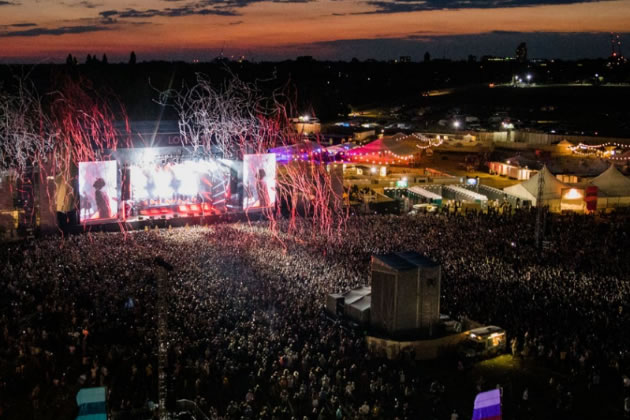
A previous event in Gunnersbury Park. Picture: Festival Republic
April 9, 2026
The review of the premises licence for Gunnersbury Park by Hounslow Council has ended with the introduction a series of new conditions on events at the venue but they fall short of the more wide-ranging restrictions demanded by local residents’ groups.
Following a lengthy hearing on 27 March 2026, the Licencing Panel led by Councillor Dan Bowring, has announced a measures intended to address the most persistent complaints about noise, litter, drugs management and communication with local people.
The review was brought by the Gunnersbury Park Garden Estate Residents Association (GPGERA), whose chair Pete Bainbridge made clear from the outset that his group was not seeking to end events at the park altogether, but wanted to see fewer of them, at lower volumes, with stronger protections for the surrounding community. Over 100 local residents submitted representations in support of the review, and at the hearing itself a succession of speakers described the impact of large music festivals on daily life — from bass vibrations penetrating double-glazed windows more than a mile away, to an armed robbery allegedly carried out under cover of festival noise, to concerns about open-air drug dealing and the stench from poorly maintained portable toilets.
During the hearing, Stephen Peiris, a policing panel Chair and resident in Gunnersbury, described the night three men armed with swords broke into his mother’s home whilst a festival was taking place in Gunnersbury Park.
According to the resident, the noise of the nearby festival was so loud that it entirely masked the sound of the break-in. Inside her bedroom, the men threw her to the floor, smashed her jewellery box and two of the men held swords to her throat.
He told the panel that a police detective later suggested the criminals likely chose the night of the festival to use the noise as cover. They successfully escaped by disappearing into the festival crowd.
The panel heard from the residents' association, the park's operator Gunnersbury Estate (2026) CIC, environmental health officers, the council's licensing enforcement team, a ward councillor and a number of acoustic consultants. The Metropolitan Police, who had previously described the events as well-run, did not attend to represent themselves. The panel noted that neither the police nor environmental health had made any formal objection, and that the licensing authority itself had reported a positive working relationship with the park's management. The CIC's representatives leaned heavily on this during the hearing, arguing that because no breach of the existing licence had occurred, punitive action would be disproportionate.
The panel ultimately agreed that the absence of formal breaches did not mean the existing conditions were adequate. In its written decision it found that the weight of evidence from residents — consistent both in writing and in person — demonstrated that the current licence terms were insufficiently rigorous and that continuing them unmodified was likely to perpetuate an unacceptable level of nuisance and antisocial behaviour. On that basis it chose to modify the conditions attached to the licence rather than suspend or revoke it.
The changes that have been made cover several areas. The categories defining the scale of events have been redefined, with the largest category now capped at 29,999 people at any one time. A drugs policy must now be drawn up in conjunction with the police for each event, covering search procedures, disposal and the reporting of any intelligence about drug dealing or organised crime. The waste management conditions have been tightened, with litter picking now required along agreed routes in the surrounding streets, not just inside the park, and toilet facilities must be cleaned regularly with records kept to prove it. Toilet waste must be removed in sealed containers and must not under any circumstances be deposited on the ground — a specific response to the complaints about the practice of jet-washing cubicles and allowing the run-off to soak into the park's grass.
On noise, the panel retained the existing headline limit of 75 decibels measured over a fifteen-minute period at the nearest noise-sensitive premises, but added considerably more structure around how compliance is monitored and enforced. For larger events, a qualified acoustic consultant must be engaged, paid by the licence holder but required to act independently, with full authority to turn down the volume if limits are being approached. Raw monitoring data — not just summaries — must be made available to council officers on demand, a direct response to the concerns raised at the hearing about whether the council had previously been receiving only processed results. Monitoring locations must be agreed with environmental health in advance, and if the council's noise officers do not approve an event's noise management plan, that event cannot go ahead.
The conditions around communication and resident liaison have also been strengthened. The park operator must now maintain a list of local residents' groups and councillors and notify them directly by email at least two weeks before any planned event. A dedicated resident liaison manager must be employed for larger events, and a contact email address must be monitored daily throughout the build, operation and dismantling of each event. An incident log recording crimes, ejections, disorder and drug seizures must be kept and made available to police or council officers on request. Drinks must not be served in glass containers at public areas within the event site.
However, the panel declined to go as far as the residents had wanted on several of the most significant points. The request for a noise limit capped at 65 decibels — in line with what campaigners argued was the standard recommended by the so-called Pop Code and applied at parks such as Hyde Park and Brockwell Park — was not adopted. The 75 decibel limit remains on the face of the licence, though the new framework around noise management plans gives environmental health officers considerably more power to negotiate lower limits for individual events and to enforce them once set. The panel also did not impose a fixed reduction in the number of event days, which had been one of the association's central demands. Campaigners had been asking for roughly half the current number; the new conditions do not address this directly.
The panel was also explicit that it was uncomfortable approving conditions that the CIC had proposed as a package, having negotiated them in advance with council officers, without those conditions having been properly consulted upon by all parties. It invited the licence holder to pursue any further amendments it wanted through a formal variation application, which would require public notification and give residents the opportunity to respond. Until such an application is made and determined, the modified conditions now in force will govern the park's events programme.
For campaigners, the decision is likely to feel like a partial and somewhat frustrating outcome. The panel validated their core argument — that the existing licence was not fit for purpose and was allowing real harm to residents — and it has introduced meaningful new protections around transparency, noise monitoring, waste management and resident communication. The requirement for environmental health to approve noise management plans before events can proceed, and the insistence on raw data being available to officers, addresses a specific and important gap that residents had identified. The drugs policy requirements and the incident log conditions also represent a more rigorous framework than previously existed.
But the decision stops short of the structural changes the association was seeking. GPGERA said the ruling acknowledges that residents have suffered “real harm”, but argues the outcome still fails to address the fundamental problems caused by large-scale events in the park. Although the panel refused requests for more events or higher noise limits and introduced some procedural changes, residents say these measures fall short after “more than 300 pages of resident evidence and over 600 complaints in 2025 alone” . They remain concerned about persistent noise, antisocial behaviour, litter, pressure on the park, and what they describe as inadequate and non-independent enforcement. A central criticism is that the CIC continues to “oversee its own compliance” by appointing and paying the noise consultants monitoring its activities, which residents argue undermines trust and embeds a system that has already failed them .
The statement warns that confidence in the council is eroding, particularly as residents feel procedural issues were mishandled, including late evidence submissions and inconsistent filtering of material. They also highlight that many of the submissions listed as supporting the CIC were linked to trustees, employees or PR interests, inflating the appearance of public backing. With no decision yet issued on the 10-year planning application and fears that further licensing changes may follow, residents say they are being pushed toward legal action, a situation they describe as damaging for the community and for the future of the park.
Chiswick Gunnersbury councillor, Ron Mushiso, says his colleagues and he have been hearing the same concerns from residents since 2018 about noise and antisocial behaviour, and that although the review addressed some issues, the final decision still falls short of what residents had wanted. He argues that many people now feel they must brace for another summer of disruption and stresses that the new conditions must be enforced rigorously rather than treated as a formality. He says councillors will continue supporting residents and pushing for their experiences to be taken seriously.Cllr Joanna Biddolph describes the decision as extremely disappointing, saying residents repeatedly made clear that the festivals are too loud, too frequent and take up too much of the park during the summer. She notes that complaints last year came from as far as Hammersmith, and argues that if noise limits are technically being met yet people still experience intrusive sound and vibrations, then the limits themselves are too high. She says the revised licence fails to address the three main problems residents face: sound levels, low-frequency vibrations and the number of days and evenings when the park and nearby homes are affected.
She also strongly criticises the way the licence review and hearing were conducted, describing the process as irregular and unfair to residents. Her concerns include late changes to what residents were allowed to submit, the park team being permitted to provide material after the deadline, uncertainty over speaking times, the timing of the meeting, and what she describes as inappropriate political pressure during the hearing. She argues that reasonable requests—such as aligning decibel limits with Hyde Park and reducing the number of festival days—were ignored. She says she will continue supporting residents, noting that similar complaints have been raised since the days of Lovebox and Citadel and should not still be happening eight years later.
Cllr Vickram Grewal says the licence review offered residents a rare chance to challenge a system that, in his view, does not reflect what local people should reasonably expect. Although he was aware from colleagues that the issue was significant in Chiswick Gunnersbury, he says it was only through speaking directly with residents that he understood the full extent and consistency of their concerns. He describes hearing repeatedly from households—many well beyond the immediate vicinity of Gunnersbury Park—who felt their summers had been disrupted by weekends when they could not enjoy their gardens and by persistent vibrations that made being indoors as uncomfortable as being outside. He says he was struck by how widespread and deeply felt these experiences are.
The panel's suggestion that the licence holder pursue further changes through a variation application creates an opening for ongoing negotiation, but it also means that residents will need to remain engaged and ready to participate in another formal process if they want further concessions. The right of appeal to a magistrates' court within 21 days applies to all parties, meaning the CIC could challenge the modifications imposed, and the residents' association could in theory appeal the panel's failure to go further.
Like Reading Articles Like This? Help Us Produce More This site remains committed to providing local community news and public interest journalism. Articles such as the one above are integral to what we do. We aim to feature as much as possible on local societies, charities based in the area, fundraising efforts by residents, community-based initiatives and even helping people find missing pets. We’ve always done that and won’t be changing, in fact we’d like to do more. However, the readership that these stories generates is often below that needed to cover the cost of producing them. Our financial resources are limited and the local media environment is intensely competitive so there is a constraint on what we can do. We are therefore asking our readers to consider offering financial support to these efforts. Any money given will help support community and public interest news and the expansion of our coverage in this area. A suggested monthly payment is £8 but we would be grateful for any amount for instance if you think this site offers the equivalent value of a subscription to a daily printed newspaper you may wish to consider £20 per month. If neither of these amounts is suitable for you then contact info@neighbournet.com and we can set up an alternative. All payments are made through a secure web site. One-off donations are also appreciated. Choose The Amount You Wish To Contribute. If you do support us in this way we’d be interested to hear what kind of articles you would like to see more of on the site – send your suggestions to the editor. For businesses we offer the chance to be a corporate sponsor of community content on the site. For £30 plus VAT per month you will be the designated sponsor of at least one article a month with your logo appearing if supplied. If there is a specific community group or initiative you’d like to support we can make sure your sponsorship is featured on related content for a one off payment of £50 plus VAT. All payments are made through a secure web site. |