Radiators Noisier Than a Bag of Spanners?
Ad - The Italian Plumber tells you about 5 things that could be responsible
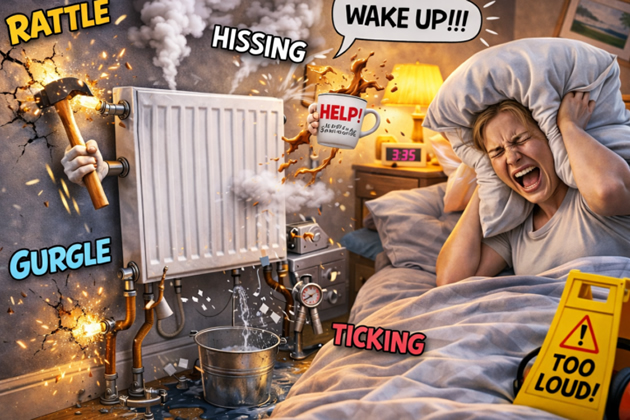
Radiators noisier than a bag of spanners?
5 things that could be responsible for making those awful noises.
Your home is meant to be your sanctuary; your place for relaxing and enjoying time with family. It should be a den of zen and tranquillity to be savoured after a hard day at the office.
So, the last thing you need is for that peace to be broken by the incessant noise of a faulty radiator system. Here are the most common causes – unfortunately, there isn’t really a DIY fix, so you will have to get a professional in to sort it.
- Dirty system
Over time, central heating systems collect sludge made up of rust, limescale, and general debris. This build-up circulates around the pipework and can settle inside radiators, restricting the flow of water. When water struggles to move through the system, you may hear gurgling, bubbling, or knocking sounds.
A dirty system can also create cold spots on radiators and make your boiler work harder than it should. In many cases, a professional system clean or power flush will remove the debris and restore smooth water flow, which usually stops the noise and improves heating efficiency. - Old or sticking radiator valves
Radiator valves can wear out over time, especially in older systems. Inside the valve is a small moving component that controls the flow of hot water. When it becomes stiff or partially stuck, the water can push past unevenly, creating whistling, rattling, or knocking sounds.
If a valve is starting to fail, you may also notice difficulty adjusting the heat or a radiator that doesn’t respond properly when you turn it up or down. In most cases, replacing the valve is a straightforward job and can quickly solve the problem. - Radiators expanding as they heat up
Radiators are made of metal, and metal naturally expands when it heats up. When your heating first switches on, the radiator warms from cold to hot and the metal begins to expand. As it moves very slightly against its fittings or pipe connections, it can create the familiar “tick, tick, tick” sound.
This is particularly common with older radiators that have been in place for many years. While it can be annoying, it’s usually harmless and simply part of the heating process. However, if the noise is excessive, a plumber may be able to adjust the pipework or mountings to reduce the movement. - Radiator brackets on the wall
Most radiators are mounted on metal brackets/hooks attached to the wall.
The radiator sits on these hooks and expands slightly as it heats up.
If there is metal-on-metal contact between the radiator and the bracket, that movement can create a clicking or creaking sound. - Smart thermostats and multiple radiators
Smart thermostats and modern heating controls are great for managing temperature and saving energy. But when only a few radiators are in use (rather than all of them), you might hear a hissing noise. There are three potential causes for this:
- Excessive pump speed: Modern boilers often have high-efficiency pumps that can be set to different speeds. If the pump is moving too much water for the size of your system, it can create turbulence and noise.
- Missing or incorrectly set automatic bypass valve (ABV): When thermostatic radiator valves (TRVs) shut off, the pressure in the system increases, leading to water noise in the remaining open radiators. An automatic bypass valve provides an alternative path for the water, preventing this pressure build-up.
- Unbalanced system: If the lockshield valve (the non-TRV valve) is nearly closed on one or more radiators, it can restrict flow and cause a high-pitched hissing or rushing noise.
Don’t lose your sanity over a noisy radiator.
Get in touch and we’ll get your zen fully restored in no time.
Samuele The Italian Plumber
Other blog posts by Samuele can be read at theitalianplumber.co.uk/blog.
Until next time, if you have any plumbing or heating issues around the home, give us a call on 020 8945 7457.
Advertisement
April 23, 2026
Related links
|
