Developer Leaves Door Open to Keeping Chiswick Tower as Offices
Latest proposal rethinks the entrance to Gunnersbury Station
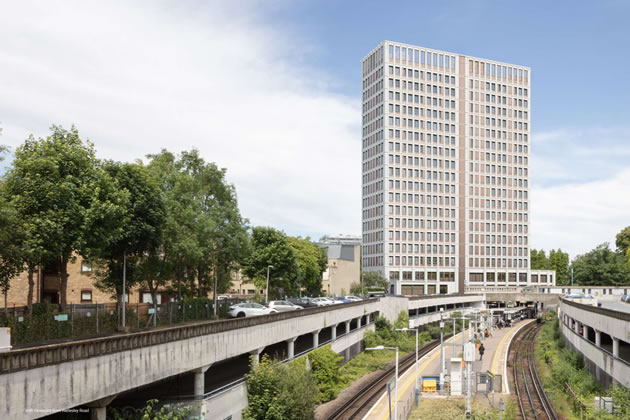
A visualisation from the developer of the reclad Chiswick Tower
June 20, 2026
The assumption that Chiswick Tower is about to be converted into nearly 400 co-living apartments is looking less certain following the latest planning application submitted for the building. Although it does not rule out continuing with the scheme that was approved late last year, it has left the door open to retaining the current use of the building as offices rather than residential.
A new submission for 389 Chiswick High Road represents the latest piece in an increasingly layered planning picture for the prominent but unloved office tower. It seeks permission for a comprehensive façade replacement alongside a modest ground floor rear extension and rooftop rationalisation.
The current application, prepared by Assael Architecture on behalf of Chiswick Tower Limited, proposes replacing the existing cladding — now over 30 years old and widely regarded as poor quality — with a high-performance system using cream stone-effect aluminium frames and bronze-finish metal infill panels. All materials would meet the latest fire rating standards, a significant upgrade from the current specification. The existing structural frame is retained throughout.
A small single-storey rear extension of 71 square metres is proposed to rehouse an enlarged substation and improved refuse storage. At roof level, redundant plant housing and would be removed, with the space rationalised into a single ancillary room with terrace access — all sitting within the existing parapet height.
The application sits within a dense web of prior decisions most directly following permission P/2025/2545, granted in December 2025, which approved a cladding replacement using openable windows and integrated replacement panels. The current application is described as following on from that consent and adopting the same design principles and aesthetic — meaning planners have already once endorsed this architectural approach.
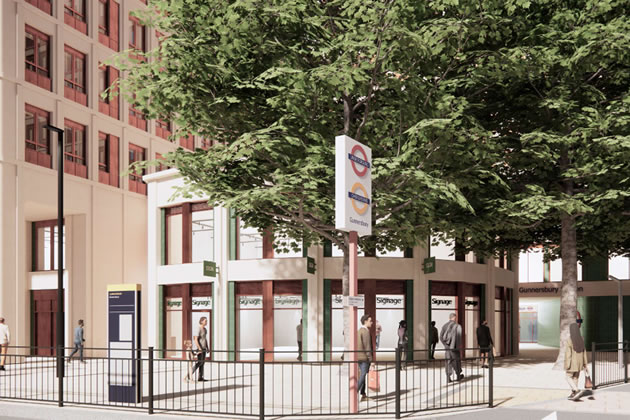
The latest design for the station entrance from the developer
The relationship with the co-living application (P/2025/0794) is more complex. That scheme, which was resolved to be approved by the London Borough of Hounslow at committee in December 2025 though with a Section 106 still being finalised, proposed converting the tower into purpose-built shared living accommodation and replacing the annex with a new nine-storey residential block. The current façade application does not supersede or undermine the co-living permission. The planning statement explicitly notes that the proposed façade would function for both office and residential uses, and the ground floor extension proposed here mirrors — and is actually smaller than — the equivalent extension already approved under the co-living scheme, which was two storeys.
If the co-living scheme progresses and the Section 106 is signed, the façade consent could be implemented as part of that conversion. If the building remains in office use — and the planning statement is careful to assess the application on that basis, noting that no works relating to the prior approval residential conversions have commenced — the cladding remains equally appropriate. The applicant also holds two prior approval consents (PAC/2025/0749 and PAC/2025/3503) permitting conversion to 181 and 197 flats respectively under permitted development rights, adding further optionality.
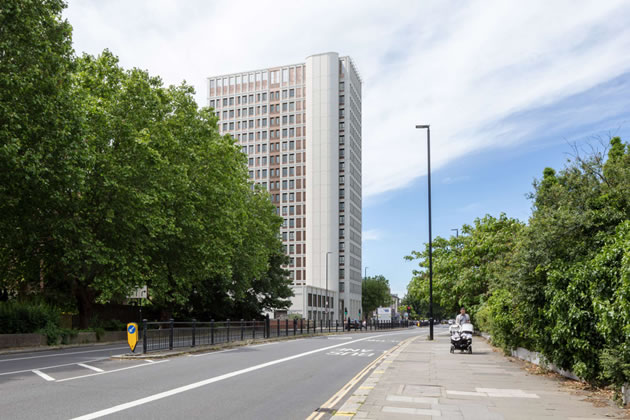
A visualisation of the reclad tower looking west along Chiswick High Road
In effect, the façade application functions as a consent that is deliberately agnostic about the building's eventual use, providing an architectural upgrade that unlocks value regardless of which development route is ultimately pursued.
Perhaps the most publicly significant dimension of the proposal concerns Gunnersbury Station, which is accessed directly beneath Chiswick Tower. The existing station entrance is widely criticised in the design documents as poorly laid out, with inadequate wayfinding and an uninviting ticket hall. The current application directly addresses this, though it is worth being precise about what is and is not within its scope.
The re-cladding of the curved base of the tower, combined with the redesigned ground floor frontage, is intended to significantly improve the station entrance environment. Distinctive glazed green tiles mark the station access point and are repeated as a wayfinding device across the base of the building. The re-clad extension opens up what is currently a heavy, inactive facade to create a lighter and more welcoming approach. New signage zones are incorporated into the design. The planning statement describes the outcome as a "lighter, more welcoming walkway into the station" that activates the adjacent public realm.
These are meaningful improvements, but they are improvements to the environment around the station entrance rather than to the station infrastructure itself. The application does not alter the station structure, platforms or operational arrangements. What it does do is address what the design documents identify as a longstanding failure of the building to acknowledge its role as a gateway to public transport — a failure that has persisted since the tower was last re-clad in 1995.
The co-living application, had it included demolition of the annex, would have more dramatically reconfigured the relationship between the building and the station forecourt. The current application is more conservative in scope but delivers improvements that are arguably overdue regardless of what happens to the tower's upper floors.
The planning statement assesses the proposal against Local Plan policies, and the design takes care to reference the original 1960s building by Raymond Spratley & Partners, whose strong horizontal structural grid gave the tower a coherent architectural identity that the 1995 re-cladding diluted. The new façade seeks to reinstate that clarity through a rhythmic grid of cream frames and bronze infill panels, with vertical breaks softening the massing and a crown treatment using tall parapet openings to reduce the building's perceived bulk.
The tower is not listed and the site does not fall within a conservation area, though the Heritage Townscape Visual Impact Assessment — carried over from the earlier P/2025/2545 application — concludes that the proposal would have no adverse impact on surrounding heritage assets and could be considered a positive contribution to the streetscape along Chiswick High Road.
What this application ultimately represents is a carefully calibrated move that advances the owner's interests without limiting its options. It would deliver an upgrade to a building whose current facade is unattractive and environmentally inefficient. It builds on a consent already granted, applies a design already reviewed and endorsed, and does so in a way that is compatible with multiple possible futures for the building. The station access improvements, while not transformative in isolation, would represent a genuine improvement for the many thousands of passengers who use Gunnersbury Station daily.
Although the plan does not block any future upgrade of Gunnersbury station, it does not provide any funds for an upgrade. The feasibility work which has been published so far remains high level with no detailed designs or costings and neither the station owner Network Rail or Transport for London have funding available for this station.
Like Reading Articles Like This? Help Us Produce More This site remains committed to providing local community news and public interest journalism. Articles such as the one above are integral to what we do. We aim to feature as much as possible on local societies, charities based in the area, fundraising efforts by residents, community-based initiatives and even helping people find missing pets. We’ve always done that and won’t be changing, in fact we’d like to do more. However, the readership that these stories generates is often below that needed to cover the cost of producing them. Our financial resources are limited and the local media environment is intensely competitive so there is a constraint on what we can do. We are therefore asking our readers to consider offering financial support to these efforts. Any money given will help support community and public interest news and the expansion of our coverage in this area. A suggested monthly payment is £8 but we would be grateful for any amount for instance if you think this site offers the equivalent value of a subscription to a daily printed newspaper you may wish to consider £20 per month. If neither of these amounts is suitable for you then contact info@neighbournet.com and we can set up an alternative. All payments are made through a secure web site. One-off donations are also appreciated. Choose The Amount You Wish To Contribute. If you do support us in this way we’d be interested to hear what kind of articles you would like to see more of on the site – send your suggestions to the editor. For businesses we offer the chance to be a corporate sponsor of community content on the site. For £30 plus VAT per month you will be the designated sponsor of at least one article a month with your logo appearing if supplied. If there is a specific community group or initiative you’d like to support we can make sure your sponsorship is featured on related content for a one off payment of £50 plus VAT. All payments are made through a secure web site. |